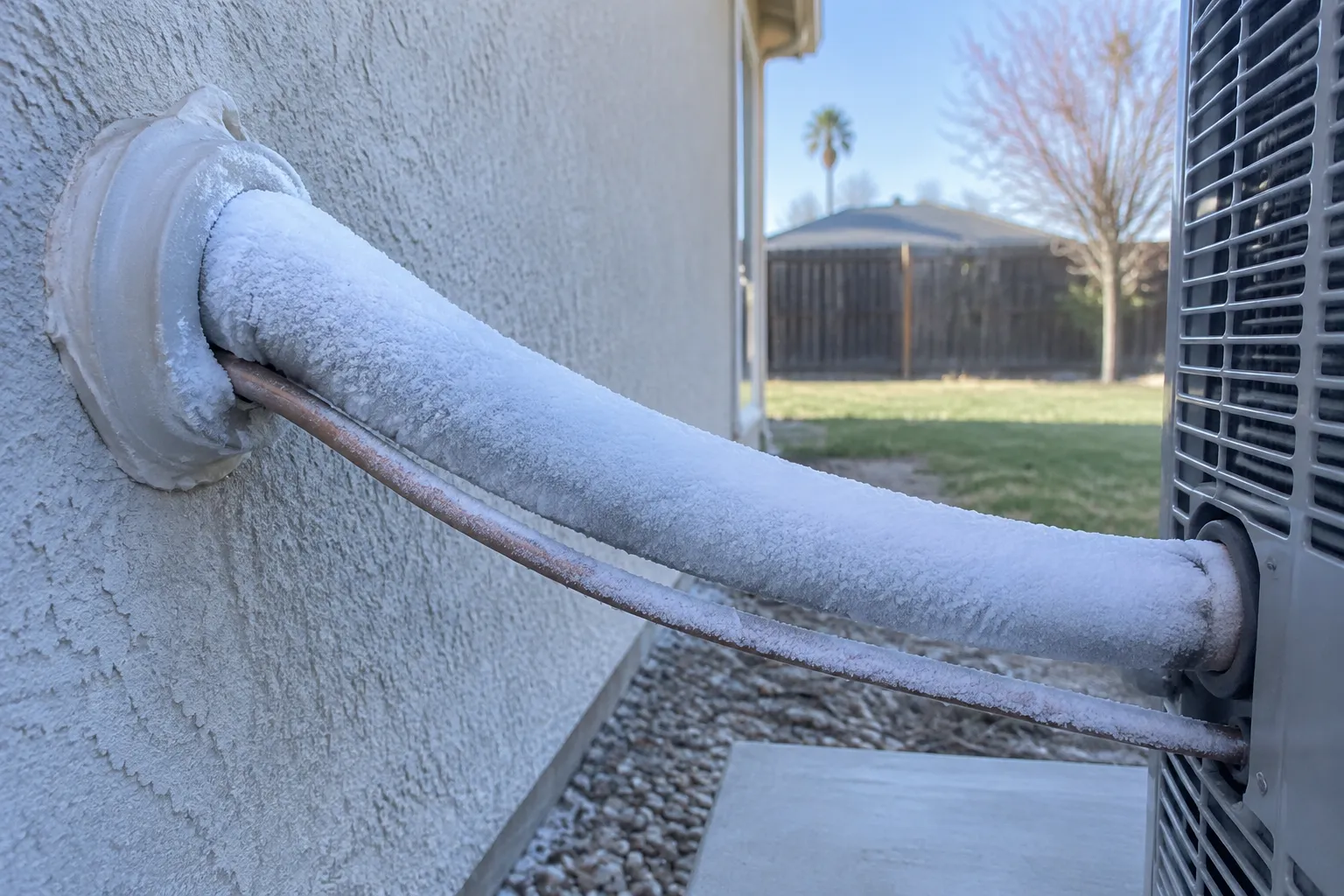
When your AC is freezing up, ice forms on the indoor evaporator coil or on the refrigerant line, and the air from your vents turns weak or warm. Manufacturers such as Trane name restricted airflow as the biggest reason, usually a dirty filter, blocked return vents or a dirty coil. Low refrigerant from a leak is the other main cause. Turn the thermostat off, let the ice melt and change the filter. If it freezes again, the cause is deeper and needs a specialist. Published national repair ranges for the likely fixes run from about $75 to $2,700. For a full picture of cooling problems, start with AC blowing warm air.
Why does my AC keep freezing up?
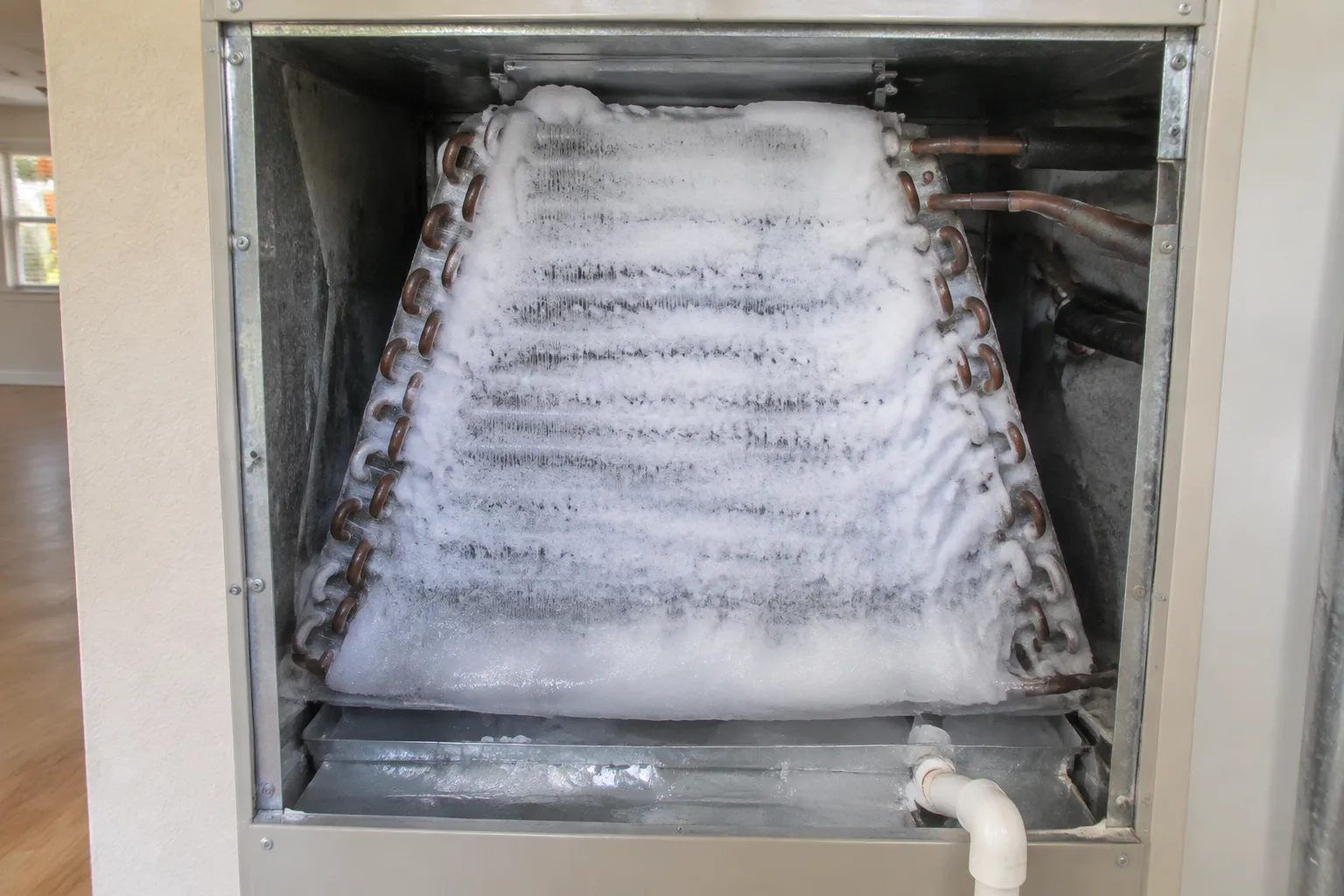
Your AC freezes when the indoor coil gets so cold that moisture on it turns to ice. Restricted airflow is the usual cause: a clogged filter, closed or blocked vents, or a dirty coil. The other major cause is low refrigerant, which drops pressure and temperature in the coil. A faulty thermostat can also contribute.
Here is how those causes work:
- Airflow. Warm house air should flow across the coil constantly. When a filter is packed with dust or a return vent is blocked, not enough warm air reaches the coil, and it chills below freezing.
- Low refrigerant. Refrigerant does not get used up in normal operation. If the level is low, the system has a leak. Lennox explains that the lower level cuts pressure in the coil, so the coil gets too cold and freezes. Carrier says low refrigerant is not a normal condition for a properly sealed system.
- Dirty coil. Dust on the evaporator coil acts like insulation and blocks heat transfer.
- Cool weather. Lennox notes that running an AC when the outdoor temperature is below about 60 F can cause freeze-up.
- Thermostat or fan faults. A thermostat that misreads temperature or a blower that is not moving enough air can have the same effect.
Water from melting ice can overflow the drain pan and look like a leak. If you see water, read AC water leaking.
What should you do when your AC is frozen?
Switch the thermostat to off, then set the fan to on so air moves across the coil and melts the ice. Replace the air filter if it is dirty. Do not chip or scrape the ice, because that can damage the coil. Running a frozen system can cause major damage, so do not keep cooling.
Step by step:
- Turn the thermostat to off. Leave the fan on if you can, as Lennox advises, to speed the thaw.
- Replace a dirty filter. Trane and Carrier both advise changing filters every one to three months depending on the filter.
- Check that supply vents and return grilles are open and not blocked by furniture or rugs.
- Place towels or a shallow pan under the indoor unit in case melting ice overflows the drain pan.
- Wait until the ice has fully melted before turning cooling back on. There is no sourced standard time, and it depends on how much ice formed.
- Restart with the cooling mode and watch whether ice returns.
If it freezes again soon after, airflow was probably not the only issue. That points toward a refrigerant leak, a failing blower or a thermostat fault. Refrigerant work is for a pro. Under EPA Section 608, only technicians with EPA Section 608 certification, or their employers, may buy refrigerant for stationary AC equipment, and knowingly venting it is prohibited. A can from a store will not solve a leak.
Is it the outdoor unit, the line or the indoor coil that is freezing?
Ice can show up in three places. On the indoor coil it usually means airflow or refrigerant trouble. On the thick copper line, often called the suction line, it points the same way, most often low refrigerant. On the outdoor unit it can mean a refrigerant, fan or cold-weather problem. In all three cases, shut the system off.
Indoor coil. You may not see it unless you open the air handler, and you should not. Signs are weak airflow, warm air, water around the indoor unit and frost on the line outside the cabinet.
Refrigerant line. The larger insulated line that runs to the outdoor unit can sweat or frost. If it is coated in ice, the coil is probably iced too. Do not pull the insulation off or hit the ice.
Outdoor unit. Frost on the outdoor coil, or ice on the unit's fittings, can happen with low refrigerant or when running in cool weather. In Modesto the issue is less about winter and more about a failing system, since summer highs average about 95 F in 1991 to 2020 climate data compiled by Climates to Travel. A frozen outdoor unit on a hot day is a clear sign of a fault.
If the system freezes and also stops cooling at all, the compressor or capacitor may be involved. See AC compressor repair for those signs, and AC running but not cooling for what else to rule out.
What does it cost to fix an AC that keeps freezing up?
The cost depends on the cause. A new filter costs very little. A diagnostic or service call runs about $75 to $250 and refrigerant leak repair $200 to $1,500 in Fixr's January 2026 guide. A replacement evaporator coil runs $400 to $2,700. A clogged drain or a coil cleaning depends on the access and the labor, so ask for those priced separately.
| Cause | Typical fix | Published national range |
|---|---|---|
| Dirty filter or blocked vents | Replace filter, clear vents | Cost of the filter |
| Diagnostic or service call | Find the cause | $75 to $250 |
| Clogged condensate drain | Clear the line | Depends on access and labor |
| Dirty evaporator coil | Professional cleaning | Depends on access and labor |
| Refrigerant leak | Repair the leak and recharge | $200 to $1,500 |
| Faulty thermostat | Replace or recalibrate | $150 to $500 |
| Failed evaporator coil | Replace the coil | $400 to $2,700 |
Figures are from Fixr's published AC repair guide (January 2026). No source for this page gave Modesto-specific prices, and your quote depends on the unit, how easy it is to reach and the specialist. If a technician proposes a coil replacement, ask what failed and whether a leak was found, because replacing a coil without fixing a leak leads to the same freeze-up. A fuller look at pricing is on AC repair cost.
How do you stop an AC from freezing up again?
Change the filter on a schedule, keep vents and returns open, keep plants and debris away from the outdoor unit, and have the coil checked each year. Do not run the AC in cool weather. If ice keeps coming back, the system needs a professional check for a leak or airflow fault.
Filters are the easy win. Trane advises checking or changing them every 1 to 3 months depending on the filter, and the Energy Star heating and cooling guide hosted by the Department of Energy says regular maintenance can reduce heating and cooling costs by 10 percent or more. Because Modesto sits in the San Joaquin Valley, where air quality can be poor at times, it is common sense to check the filter more often during smoky or dusty weeks, though no source tied the Valley's air to a specific filter interval.
A yearly tune-up is the other safeguard. Fixr lists an annual tune-up at about $275, and maintenance plans at $150 to $500 a year. See HVAC service plan and clean and service HVAC for what a check should include. For help comparing options, read how this works or return to the Modesto home page. Quotes on this site come from independent local businesses, and California requires a CSLB license for work worth $1,000 or more in labor and materials, which you can check at cslb.ca.gov.
Questions people ask
How long does it take to fix an AC that is freezing up?
Thawing the ice is the first step, and there is no sourced standard time for it. A diagnosis and a simple fix, such as a filter or drain clear, can be quick. A refrigerant leak or coil replacement takes longer and depends on access and parts. Ask the specialist for a time estimate with the written quote.
What should I ask before I hire someone for AC freezing up?
Ask what they found, not just what they will charge. Was it airflow, a leak or a failed part? Ask for the diagnostic fee, a written quote, and whether leak testing is included if refrigerant is low. Ask for the CSLB license number and check it at cslb.ca.gov. Skip anyone who offers to add refrigerant without finding the leak.
Do I need to be home for AC freezing up?
An adult should be home, or have someone let the technician in. They need access to the indoor unit, the outdoor unit and the thermostat, and someone must approve the quote before work begins. Move boxes or furniture away from the air handler ahead of time, and tell the specialist if pets are present.
Can I run my AC while it is frozen?
No. Trane warns that running a frozen coil can cause major damage. Turn the thermostat off, let the ice melt fully, and fix the airflow issue first. Running the compressor against a frozen coil strains the most expensive part of your system. A fan-only setting is fine for thawing.
Is a frozen AC line an emergency?
Usually not on its own. It is a sign the system needs attention soon, so shut it down and arrange a visit. It becomes urgent in a heat wave, or if water is leaking onto ceilings or floors. See HVAC emergency repair for how to judge urgency and what after-hours calls can cost.
Read on
- AC blowing warm air
AC blowing warm air? Check the thermostat, filter, breaker and outdoor unit first, then see what points to low refrigerant, a frozen coil…
- AC running, not cooling
Your AC is running but the house stays warm.
Sources
- Trane, evaporator coil is frozen
- Lennox, why is my air conditioner freezing
- Carrier, AC short cycling
- Fixr AC repair cost guide (January 2026)
- EPA Section 608 refrigerant sales restriction
- Energy Star heating and cooling guide, hosted by the U.S. Department of Energy
- Fixr HVAC maintenance guide
- Climate data for 1991 to 2020 compiled by Climates to Travel
Last updated