
If your AC is running but not cooling, the cause is usually one of four things: a dirty or blocked filter or vent, a frozen indoor coil, a fault at the outdoor unit, or low refrigerant from a leak. Check them in that order, because the first ones cost nothing. The compressor is the last suspect, not the first. If the air at the vents feels warm or only slightly cool, the page on a frozen AC unit goes into the freeze-up side in more detail. This page is the triage: what to check, in what order, and when to stop.
Why is my AC running but not cooling?
The fan and thermostat can be working while the cooling side is not, so the system looks alive but moves warm air. The usual reasons are restricted airflow, a frozen coil, a stopped outdoor unit, a refrigerant leak, or an electrical part such as a capacitor that has failed.
Match what you see to the likely cause:
- Weak airflow from vents: a clogged filter, closed or blocked vents or a dirty indoor coil. Restricted airflow is the most common reason coils freeze, according to Trane.
- Ice on the indoor unit or lines: a frozen coil, usually from airflow or low refrigerant.
- Indoor fan running, outdoor unit silent: the outdoor fan, capacitor or contactor, or a tripped breaker.
- Outdoor unit running hot and loud, warm air indoors: a dirty condenser coil, a failing fan motor or a compressor problem.
- Air that is cool, not cold, and the house never reaches setpoint: an oversized or undersized system, a leaking duct, or a slow refrigerant leak.
A system that is slightly short on refrigerant does not feel dead, it feels weak. Refrigerant is not used up in normal operation, so a low level means a leak.
What can you check in ten minutes?
Check the thermostat, the filter, the vents, the breaker and the outdoor unit, in that order. All five are safe for a homeowner and rule out the cheapest causes. If none changes anything after the system has run for a while, you have narrowed it to a fault for a specialist.
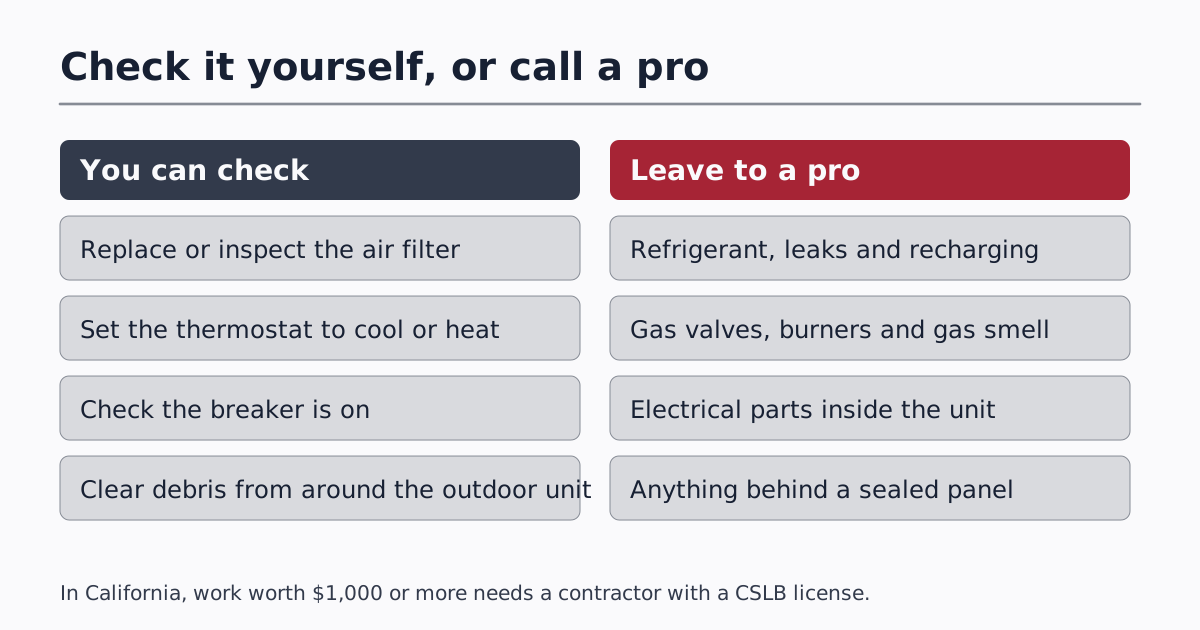
- Thermostat. Confirm it is set to cool, not heat or fan only, and that the setpoint is below the room temperature. Replace the batteries if it has them.
- Filter. Trane advises changing filters every 1 to 3 months, depending on the type. A packed filter restricts airflow and can freeze the coil.
- Vents and returns. Open the vents, move furniture and rugs off the returns and look for a collapsed or crushed duct in the attic or crawl space if you can see it safely.
- Breaker. Look at the panel for a tripped breaker for the outdoor unit. If it trips again at once, leave it off and call.
- Outdoor unit. Clear leaves and debris from around the cabinet and check that the fan is turning.
If you find ice on the indoor coil or on the lines, switch the thermostat to off and let it thaw. Do not chip it away. Trane warns that running a frozen coil can cause major damage. Once it thaws, replace the filter and try again. If it freezes again, the cause is probably refrigerant or a blower fault.
What if the AC is brand new and still not cooling?
A new AC that does not cool is usually an installation or setup problem, not a defective unit. Check the thermostat and filter, then contact the business that installed it. Common causes are a refrigerant charge that is off, restricted airflow in the ducts, a thermostat that was not configured, or a unit sized wrongly for the home.
New equipment still has to work with the ducts that came before it. A unit that is too large cools the air too fast, shuts off early and removes little humidity, so the house feels clammy, not cool. Carrier lists an oversized system as one cause of short cycling, which should be inspected by an HVAC professional. A load calculation, usually called Manual J, is how a professional confirms sizing.
Keep the paperwork. If the unit is within the installer's workmanship period or the manufacturer's warranty, report the problem in writing before you pay a second business to look at it. A new system needs a proper commissioning check, and the installer should come back to correct it. If you have a dispute, the CSLB handles complaints against contractors who hold a California license.
What if it is a heat pump, or the air outside feels cold?
A heat pump that blows cold air outside while the inside stays warm may be stuck in heating mode, or running with a fault in the reversing valve, which switches the system between heating and cooling. Check that the thermostat is set to cool first. If it is, call a specialist.
A heat pump is an air conditioner that can also run in reverse. A failed reversing valve is a published repair, listed at $350 to $700 in the Fixr heat pump repair guide, alongside other parts such as a capacitor at $100 to $400. On a heat pump, an outdoor unit that blows cool air in summer is a sign that the system is not moving heat in the direction you want. See heat pump repair for the full list of faults and costs.
What if the furnace is running but the house is not heating?
A furnace that runs but does not heat, or one that blows no air, usually points to the filter, the thermostat, the gas supply or the ignition sequence. An electric furnace that does not blow hot air may have a failed heating element, limit switch or breaker. Start with the filter and thermostat.
For a gas furnace, industry troubleshooting guides describe the sequence as: inducer fan, pressure switch, igniter, gas valve, flame, then blower. If the furnace starts and stops, a dirty flame sensor is often the cause, a $68 to $127 repair in the Fixr furnace repair guide. A failed igniter is $96 to $178. Gas valve problems are for a specialist.
If a carbon monoxide alarm sounds, move outside to fresh air and call 911. The CPSC advises that you do not go back in until responders say it is safe, and recommends an annual professional inspection of fuel-burning appliances.
What if you rent an apartment?
If you rent, tell your landlord or property manager in writing as soon as the AC stops cooling, and do not hire your own contractor without their approval. Repair responsibility usually sits with the owner, and your lease will say who to call and how.
Keep a record: the date, what you saw, any photos and a copy of the message. If the building has a shared system, the building manager will handle it. The checks above are still useful: a clean filter and a clear vent cost you nothing and may fix a problem that would otherwise wait for a repair visit.
When should you call a specialist?
Call when the checks above change nothing, when ice returns after thawing, when the outdoor unit hums but does not start, or when anything smells of burning. Do not open the unit, test the capacitor or add refrigerant. Under EPA Section 608, only technicians with EPA Section 608 certification, or their employers, may buy refrigerant for stationary AC equipment, and knowingly venting it is prohibited.
For work totaling $1,000 or more in labor and materials, California requires a CSLB license, so check the contractor at cslb.ca.gov. Fixr's AC repair guide (January 2026) lists refrigerant leak repair at $200 to $1,500 and compressor work at $600 to $3,000; published guides vary widely. For a price comparison across faults, see the AC repair cost guide.
To compare prices from local businesses, request quotes here. Quotes come from independent local businesses. You can also start from the HVAC repair in Modesto home page.
Questions people ask
Why is my AC blowing air but it is not cold?
Air that moves but is not cold means the blower is working while the cooling is not. The usual causes are a frozen or dirty coil, a stopped outdoor unit, a failed capacitor or low refrigerant. Check the filter, thermostat and breaker first. If the air is still warm, a specialist needs to test the refrigerant and electrical parts.
Can low refrigerant be topped off?
Refrigerant does not get used up, so a low level means a leak. Topping it off without fixing the leak is a short-term patch, and only technicians with EPA Section 608 certification, or their employers, may buy refrigerant for this equipment. Fixr lists leak repair at $200 to $1,500 (January 2026), depending on the leak and the refrigerant.
How do I know if my condenser is the problem?
Go outside with the AC running. If the fan on top is still, if the unit is silent, or if it is humming but not starting, the problem is at the outdoor unit. A capacitor, contactor or fan motor is far more likely than a compressor. The page on outdoor condenser repair covers those faults.
How long can I run an AC that is not cooling?
Do not keep running it. A frozen coil, a struggling compressor or a failing motor can all get worse with use. Switch it off at the thermostat, run only the fan if the coil is frozen, and call for a visit. In very hot weather, move to the coolest room and keep water handy.
Do I need to be home for the visit?
Usually someone should be, to give access to the thermostat, the indoor unit and the outdoor unit and to approve the quote. If you rent, check whether your landlord has to be present or has to approve the visit first.
Sources
- Trane, frozen evaporator coil
- Carrier, AC short cycling
- Lennox, AC freezing
- Fixr published AC repair cost guide, checked Nov 2026
- Fixr published heat pump repair guide, checked Nov 2026
- Fixr published furnace repair guide, checked Nov 2026
Last updated