An air conditioner repair service is more than the visit itself. It is a sequence: you call, a technician diagnoses the fault, you get a quote, you approve it, the repair is done and tested, and you receive an invoice and the paperwork. Each stage has a point where you can ask a question or say no. This page follows the job from start to finish and covers the California rules that apply. For a broader look at help around town, start at the HVAC repair in Modesto home page.
What does an air conditioner repair service include?
A repair service covers finding the fault, quoting the fix, doing the repair, testing that the system cools properly and giving you an invoice. It does not usually include a full tune-up, duct work or replacing the whole system, unless you ask for and approve those separately.
What the service covers, in order:
- Diagnosis. The technician asks about the symptoms and checks the system to find the fault.
- Quote. The fix is priced before work begins.
- Repair. The part is replaced or the fault is fixed.
- Test. The AC is run to confirm it cools and the electrical readings are normal.
- Invoice and paperwork. You receive a record of what was done and what warranty applies.
What it does not include is just as useful to know. A repair fixes the fault that was found. It does not promise that nothing else will fail, which is why a service visit is a separate job with a separate checklist.
What happens at each stage of a repair job?
Seven stages cover most jobs: the booking call, the arrival, the diagnosis, the quote, your approval, the repair and the test. You have a decision at two of them: whether to pay the diagnostic fee, and whether to approve the quote. Nothing should start before the second.
- The booking call. You give your address, the symptoms and the unit details. Ask for the arrival window and the diagnostic fee, which Fixr lists at $75 to $250.
- Arrival. The technician introduces themselves and the business. You are entitled to ask who they work for and to see the license number of the business.
- Diagnosis. The technician tests the likely causes in order. The fee usually covers the testing needed to find the fault.
- The quote. The technician explains the fault, shows you the part if they can, and gives you a price in writing.
- Your approval. You say yes, no or "I would like a second quote". A diagnostic fee is owed for the work done, but the repair is your choice.
- The repair. The part is replaced or the fault fixed. If a part is not on the truck, ask about the timeline and whether the quote changes.
- The test. The technician runs the system, checks the result with you and explains what was done.
Ask for the stage list when you book if you are unsure what to expect. A clear business will be happy to describe it. If you want to compare how nearby businesses handle the first visit, the page on air conditioner repair close to you goes through that part.
What California rules apply to AC repair work?
California requires a CSLB contractor license for work worth $1,000 or more in combined labor and materials. That threshold rose from $500 to $1,000 on 1 January 2025, so older websites that say $500 are out of date.
Several points follow from that:
- Check the license. Look up the business at cslb.ca.gov. C-20 is the classification for warm-air heating, ventilating and air-conditioning work.
- Splitting a job is a warning sign. Splitting one job into smaller invoices does not get around the license requirement, so treat it as a warning sign.
- Refrigerant needs certification. Under EPA rules, only technicians with EPA Section 608 certification, or their employers, may buy refrigerant for stationary AC equipment, and knowingly venting it is prohibited.
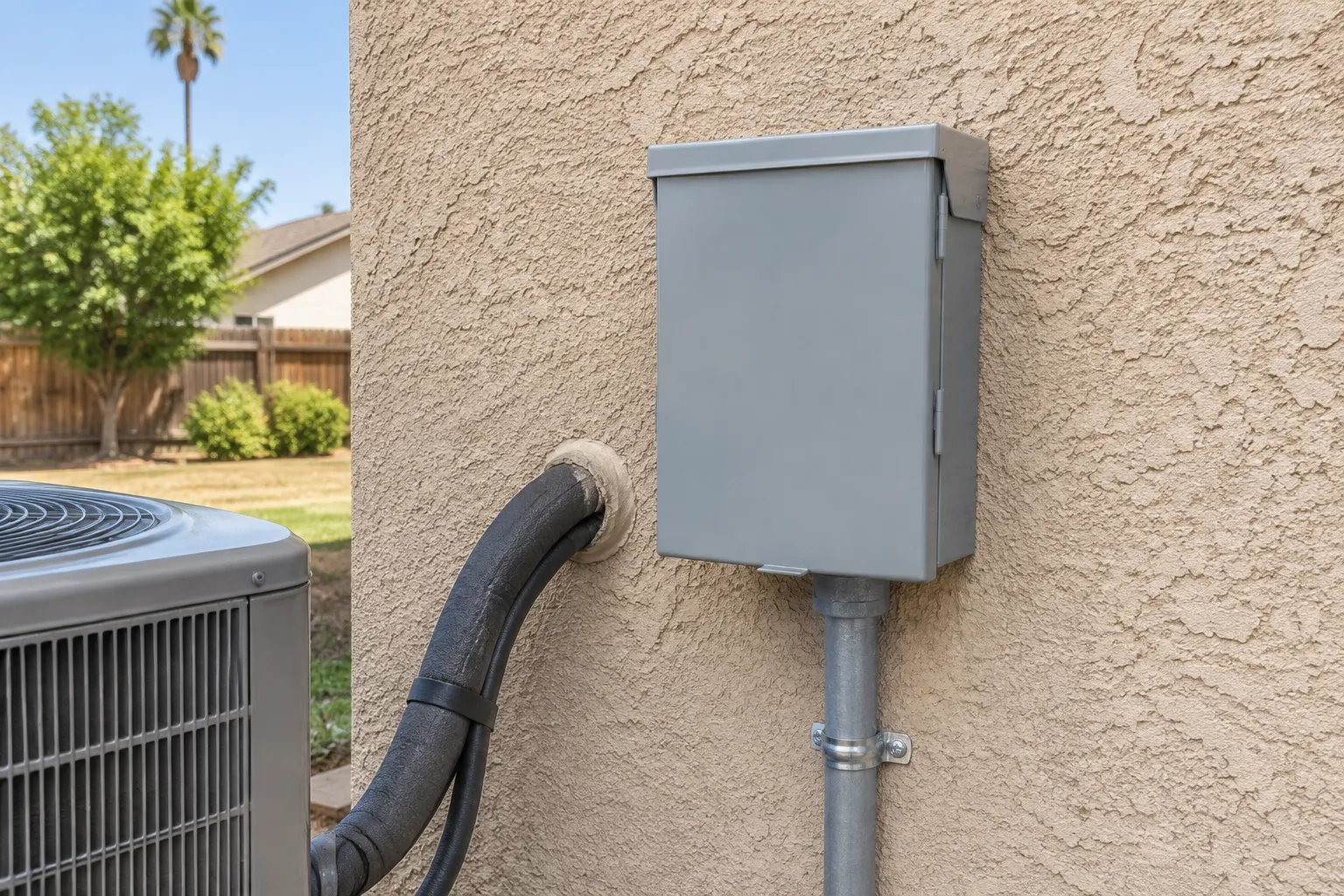
- Permits. Stanislaus County's planning fee schedule lists HVAC and wall or floor furnace permit fees. Confirm the current amount with the county before budgeting. Whether a repair or a like-for-like swap in Modesto city limits needs one was not confirmed, so ask the building department or the business.
These are the legal points, not advice about any one business. If a contractor offers to skip the permit or asks for payment in cash with no paperwork, treat that as a reason to stop and ask more questions.
What should a quote and an invoice list?
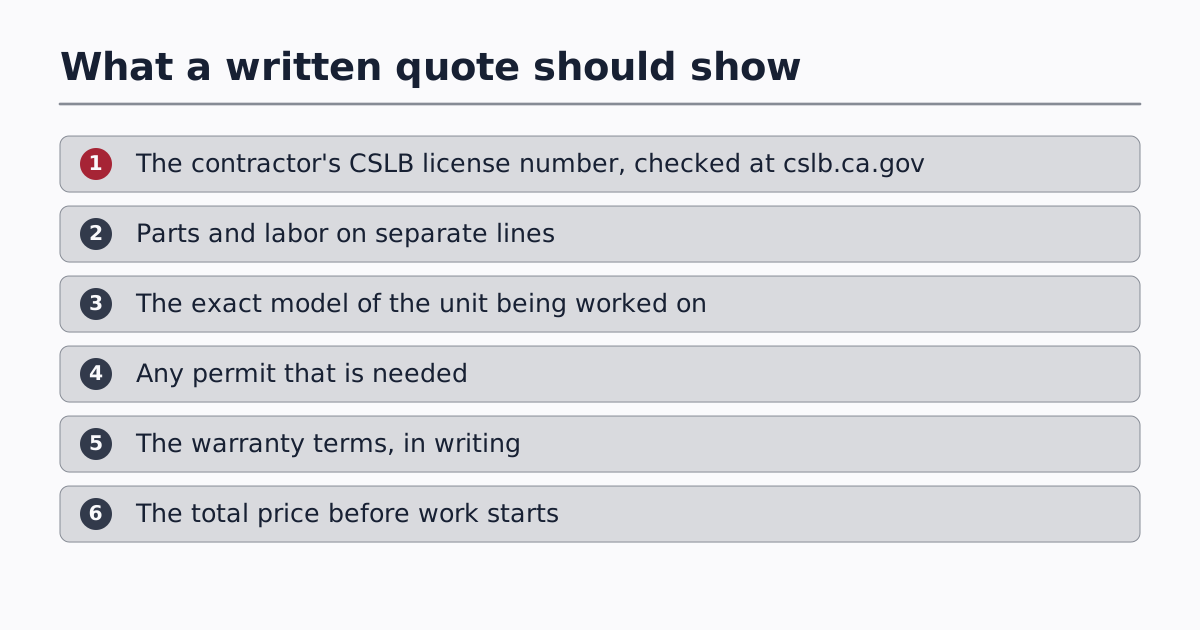
A good quote lists the fault, the part, the labor, any refrigerant, any permit or surcharge, the total, and the warranty on parts and on labor. An invoice repeats those lines with what was actually done and the final cost. Keep both with your unit's paperwork.
A short checklist for the quote:
- The business name and CSLB license number.
- The fault, in plain words.
- The part, new or not, and the brand if known.
- Labor, as a flat price or an hourly rate with an estimated time.
- Refrigerant type and amount, if used.
- The diagnostic fee and whether it is credited.
- How long the warranty lasts, and what it covers.
- The date and your approval.
The invoice should match the quote. If the final number is higher, ask what changed, and ask for the change in writing. A business should not add major work without telling you first.
What if the repair does not fix the problem?
Call the business that did the work, describe what you see and ask what their warranty on labor covers. A repair that does not hold within a short time is the business's concern first. If you do not get a clear answer, keep your invoice and quote, then ask for a second opinion.
Be specific when you report it: the date, the symptom, whether it is the same or new. A new symptom may be a different fault. A returning symptom suggests the cause was not found, for example a capacitor that fails again because a fan motor is the real problem.
For disputes with a contractor who holds a California license, CSLB handles complaints. Keep photos, messages and paperwork. Do not withhold payment without checking your agreement, and do not pay more than the quote before you have read what the extra is for.
What should you do before you book a repair service?
Check the basics yourself first: the thermostat, the filter, the breaker and the area around the outdoor unit. These cost nothing and can fix a problem that would otherwise cost a diagnostic fee. Then write down the symptoms and the model number, and decide whether you want one quote or two.
For a minor fault, one quote may be enough. For a larger one, such as a compressor, a coil or a repair that approaches half the price of a new system, compare at least two. If you would like several quotes in one request, ask for quotes here. The quotes come from independent local businesses, and how it works explains the steps.
Questions people ask
How is a repair service different from a maintenance visit?
A repair starts with a fault and ends with a fix. A maintenance visit starts with a working system and checks it for signs of wear. Both can be done by the same business, but the checklists, the prices and the paperwork differ. Fixr's maintenance guide lists a tune-up at about $275, compared with a typical AC repair range of $250 to $700 in Fixr's January 2026 repair guide.
Do I have to pay the diagnostic fee if I do not go ahead?
Usually yes, because the technician's time has been spent. Fixr lists the fee at $75 to $250. Many businesses credit it to the repair if you hire them. Ask before the visit what happens to the fee if you decline, and get the answer in writing.
What is the difference between a repair company and an installer?
Many businesses do both, but the work differs. A repair company diagnoses and fixes faults. An installer sizes and fits a new system and handles permits. If your quote includes a new system, ask for a separate price and compare it with repair, not alongside it.
How long does a repair visit take?
It depends on the fault, the part and the access. A simple electrical repair may be done in the same visit, while a motor, coil or compressor can take longer. Ask for the expected duration and whether a return visit is possible.
Do I need to be home for the repair?
Someone should be home at the start to give access and describe the problem, and at the end to see the test and sign the invoice. If you cannot be there, agree in advance who can approve the quote and how you will receive the paperwork.
Sources
- CSLB, what kind of contractor do you need
- CSLB, contractor classification C-20
- EPA, Section 608 technician certification
- EPA, refrigerant sales restriction
- Stanislaus County, building permit fees
- Fixr heat pump repair guide, January 2026, and HVAC maintenance guide
Last updated