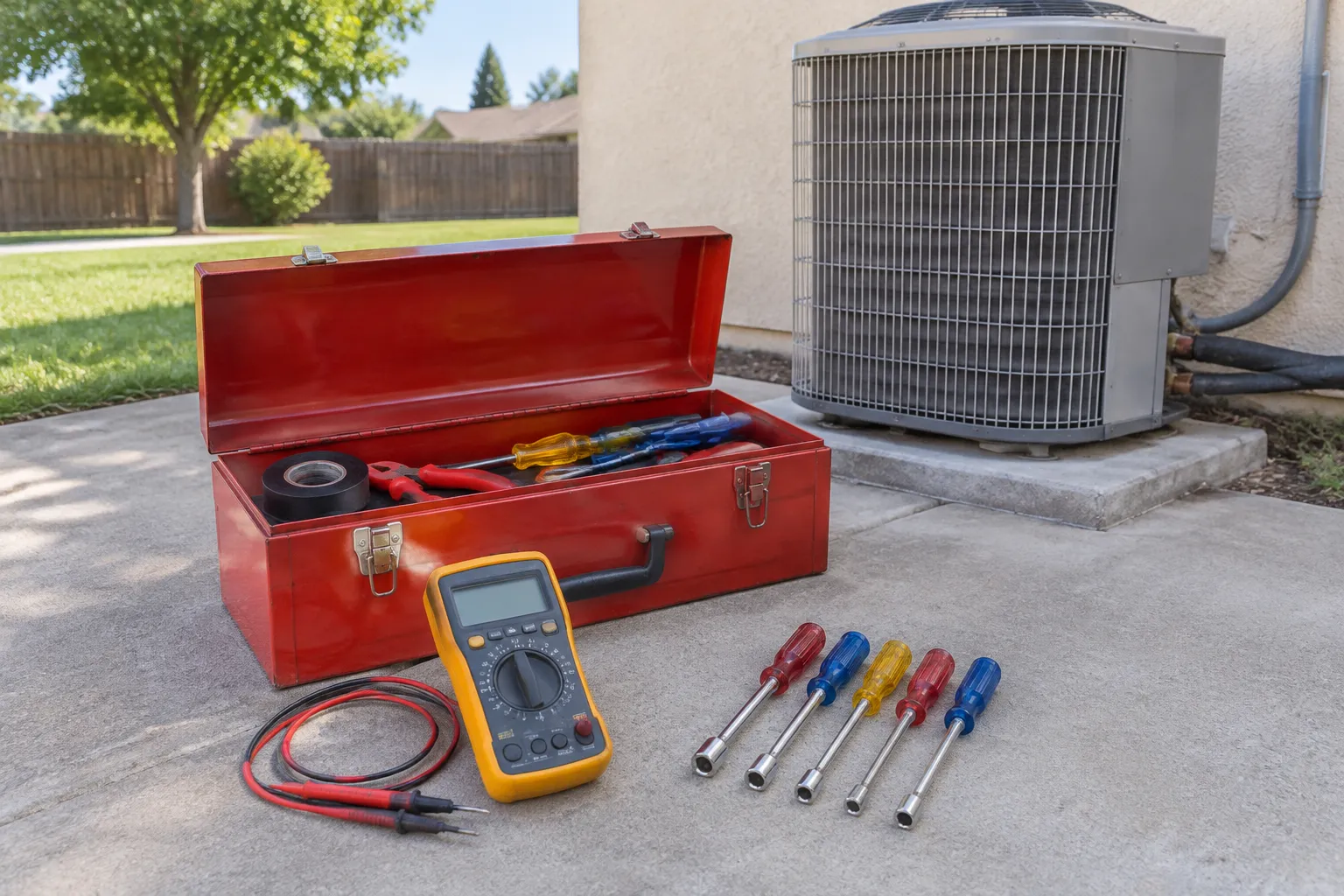
An air conditioner repair technician is a trained person who comes to your home, finds out why the system is not cooling and fixes the failed part. A typical visit runs from the thermostat to the outdoor unit and back, and ends with a written price you approve before any repair starts.
This page is about the visit itself: who turns up, what they check, what you should have ready and the questions worth asking. If you want an overview of the whole process, start from the HVAC repair quotes home page. If you want the price side, the AC repair cost guide has the ranges.
What does an air conditioner repair technician actually do?
A technician diagnoses the fault, explains it, quotes the repair and, once you agree, does the work. Most of the time goes into diagnosis. Cooling problems share symptoms, so the visit is mostly about narrowing down which of several possible parts has failed before anything is replaced.
A usual sequence looks like this:
- Questions first. What the unit is doing, when it started, whether it ran earlier today, and any noises or smells.
- Thermostat and settings. Mode, set point, batteries and whether the display matches what the system does.
- Indoor side. Filter, return and supply vents, the blower, the evaporator coil and the condensate drain.
- The outdoor unit. Fan, coil, the electrical parts in the control section, and whether the compressor starts.
- Readings and tests. Temperature drop across the coil, electrical readings on the failed part, and refrigerant checks if a leak is suspected.
- The explanation and the quote. What failed, what it costs and what the options are.
Expect the technician to open panels, so clear a path to the indoor unit and the outdoor unit before they arrive.
How should you prepare for the visit?
Clear access, a short written description of the problem and the age of the system are the three things that save time. A technician who can reach the unit immediately and hears a precise history can reach a diagnosis faster, which usually keeps the service call shorter.
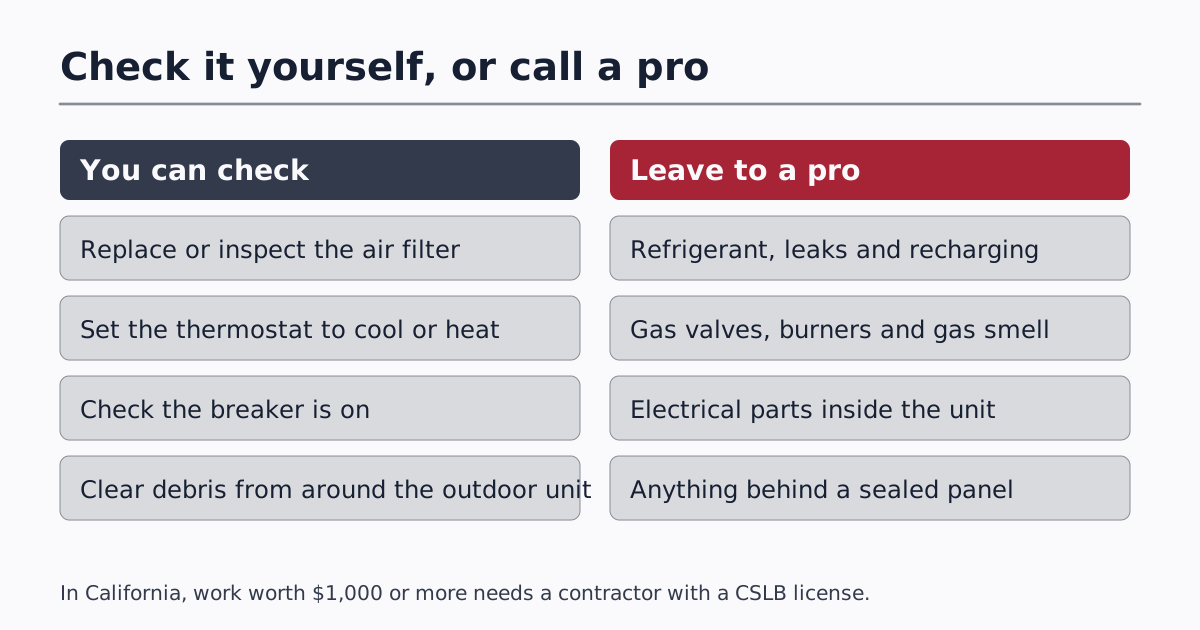
Before the visit:
- Write down the symptom. "Outdoor unit runs, air from vents is warm, started yesterday afternoon" beats "AC is broken".
- Note the age and brand from the sticker on the outdoor unit if you can read it safely.
- Replace a dirty filter and make sure the vents are open. This is a task you can do yourself, and a clogged filter is a common cause of weak cooling.
- Clear debris from around the outdoor unit and trim plants back so air can move through it.
- Check the breaker. If a breaker has tripped, tell the technician rather than resetting it repeatedly.
- Secure pets and move furniture away from the indoor unit.
Do not open the cover of the outdoor unit yourself. The capacitor and other electrical parts can hold a dangerous charge even with the power off, and Carrier says capacitor work should typically be left to a qualified HVAC professional.
What qualifications should a technician have in California?
In California, any HVAC job worth $1,000 or more in labor and materials must be done by a contractor with a CSLB license. The threshold rose from $500 on 1 January 2025. Check any business at cslb.ca.gov before work starts.
The relevant license class is C-20, which covers warm-air heating, ventilating and air-conditioning work. Separately, federal rules require anyone who services equipment that could release refrigerant to hold EPA Section 608 certification, and only technicians with EPA Section 608 certification can buy refrigerant for stationary AC equipment.
Use these checks:
- Look the business up on the CSLB License Check page and confirm the license is active.
- Ask whether the person working on refrigerant holds EPA Section 608 certification.
- Never accept a job where the license number is missing or the price is split into pieces to stay under $1,000. Splitting one job into smaller invoices does not get around the license requirement, so treat it as a warning sign.
Quotes you get through this site come from independent local businesses, so these checks are yours to make with whoever contacts you.
What should you ask before hiring someone?
Ask what the diagnostic fee is, whether it is applied to the repair, how the quote is written and whether parts have a warranty. Those four answers tell you most of what you need to compare two businesses. Fixr lists a diagnostic or service call at $75 to $250.
Consider these questions:
- Is there a diagnostic or service call fee, and is it credited if I approve the repair?
- Will I get a written quote with parts and labor listed before work starts?
- What does the warranty on parts and on labor cover, and for how long?
- If the repair costs more than expected once the panel is open, will you call me first?
- Is the technician who comes the one who will do the repair?
- Is there an after-hours or weekend surcharge for this visit, and how is it charged?
Written answers beat verbal ones. If a business will not put the price on paper, move on to the next quote. The price request form lets you describe the problem once and compare what comes back.
What will the technician find most often?
The common faults are electrical and airflow related, and many are small parts. Fixr's AC repair guide (January 2026) lists a capacitor at $100 to $400, while a contactor, fan motor or clogged drain depends on the part and the labor, so ask for part and labor on separate lines.
Bigger repairs appear less often:
| Repair | Typical US range |
|---|---|
| Capacitor | $100 to $400 |
| Refrigerant leak repair | $200 to $1,500 |
| Evaporator coil | $400 to $2,700 |
| Compressor | $600 to $3,000 |
These are published national ranges, not Modesto prices. The final quote depends on your unit, the part and the labor rate. Details on the electrical failures are on the capacitor replacement cost page.
What should you do if it is an emergency?
If it is a very hot day and someone in the house is elderly, ill or an infant, call for a same-day visit and say why. Ask for the earliest available slot and whether an after-hours surcharge applies. For smells of burning or a unit that trips the breaker immediately, switch the system off at the thermostat and wait for the visit.
Modesto summers are hot: Climates to Travel's 1991 to 2020 data gives a July average high of about 95 F, and from 2017 to 2026 Modesto logged between 12 and 45 days a year at or above 100 F, per Extreme Weather Watch (the 2026 count is incomplete). A failure on one of those days is not something to wait out. The emergency HVAC repair page covers what to expect when you need help the same day.
Questions people ask
How long does an air conditioner repair visit take?
Visit length varies with the fault. A simple repair can follow the same visit if the part is on hand. Ordering a part, searching for a refrigerant leak or a compressor job can mean a second visit. Ask the business how long they expect and whether they carry common parts.
What should I ask before I hire someone for air conditioner repair?
Ask for the CSLB license number and check it at cslb.ca.gov, ask what the diagnostic fee is and whether it goes toward the repair, and ask for a written quote before work starts. Also ask about warranty on parts and labor, and whether there is an after-hours surcharge for your visit time.
Do I need to be home for air conditioner repair?
An adult needs to be home at the start to let the technician in, show them the thermostat and agree the quote. After that, many people step out. You must approve the price before any repair that costs money. If you cannot be there, ask the business how they handle access and approval in writing.
Can I fix an air conditioner myself instead?
You can replace the filter, check thermostat settings and batteries, make sure the breaker has not tripped and clear debris around the outdoor unit. Anything involving refrigerant, capacitors or wiring belongs to a pro. Refrigerant work legally requires EPA Section 608 certification, and capacitors can hold a dangerous charge.
How do I know if the technician is quoting a fair price?
Compare at least two written quotes against the published ranges above. Check that each lists the part, labor and any fees separately. A repair that would approach 50 percent of the price of a new system is worth a second opinion, and the whole-system replacement cost guide shows what that comparison looks like.
Sources
- CSLB, What Kind of Contractor Do You Need?
- CSLB C-20 Warm-Air Heating, Ventilating and Air-Conditioning classification
- EPA, Section 608 Technician Certification Requirements
- Fixr published AC repair cost guide, checked Nov 2026
Last updated