Reliable heating and air is something you verify, not something you take on a business's word. Before anyone touches your furnace or air conditioner, check their California license at cslb.ca.gov, ask for a written quote, and confirm what the diagnostic fee covers. If you are weighing a furnace repair or replacement, those three checks filter out most of the problems people run into.
This page walks through each check in plain terms, what a good quote looks like, the red flags worth walking away from, and when a problem is serious enough that you should call someone today. It is written for homeowners in Modesto and nearby towns, where a failed system in a hot July or a cold January is hard to put off.
What does "reliable heating and air" actually mean?
Reliable heating and air means the system keeps your home comfortable without surprise breakdowns, and the specialist who services it does what they said, at the price they wrote down. The first half depends on the equipment and its upkeep. The second half you can judge before you hire anyone.
Be wary of the word itself. "Reliable" is a claim, not a credential. Nobody can show it on a license card. What you can check instead:
- A current California contractor license in the right classification.
- A written quote with the work, parts and price listed.
- A clear answer on who pulls a permit if one is needed.
- Proof that whoever handles refrigerant is allowed to.
Treat those as the real meaning of reliable. A business that is easy to check usually has nothing to hide, and one that dodges the questions is telling you something too.
How do I check a heating and air contractor's license?
Search the contractor's name or license number on the CSLB License Check at cslb.ca.gov, or call 800-321-CSLB (2752). The record shows whether the license is active and which classifications it holds. For furnaces, air conditioners and ductwork, the classification to look for is C-20, which covers warm-air heating, ventilating and air-conditioning.
California law sets the line at $1,000: work valued at $1,000 or more in combined labor and materials needs a contractor with a CSLB license. The threshold rose from $500 in January 2025, so older websites that still say $500 are out of date.
A few practical points:
- Ask for the license number in writing and look it up yourself. Do not rely on a number someone reads out on the phone.
- Match the name on the license to the name on the quote and the invoice.
- Be suspicious of a job split into two smaller invoices. Splitting work to stay under the limit is illegal.
Quotes you receive through this site come from independent local businesses, and the same rule applies to them: check each one at cslb.ca.gov before you accept.
What should a written quote include?
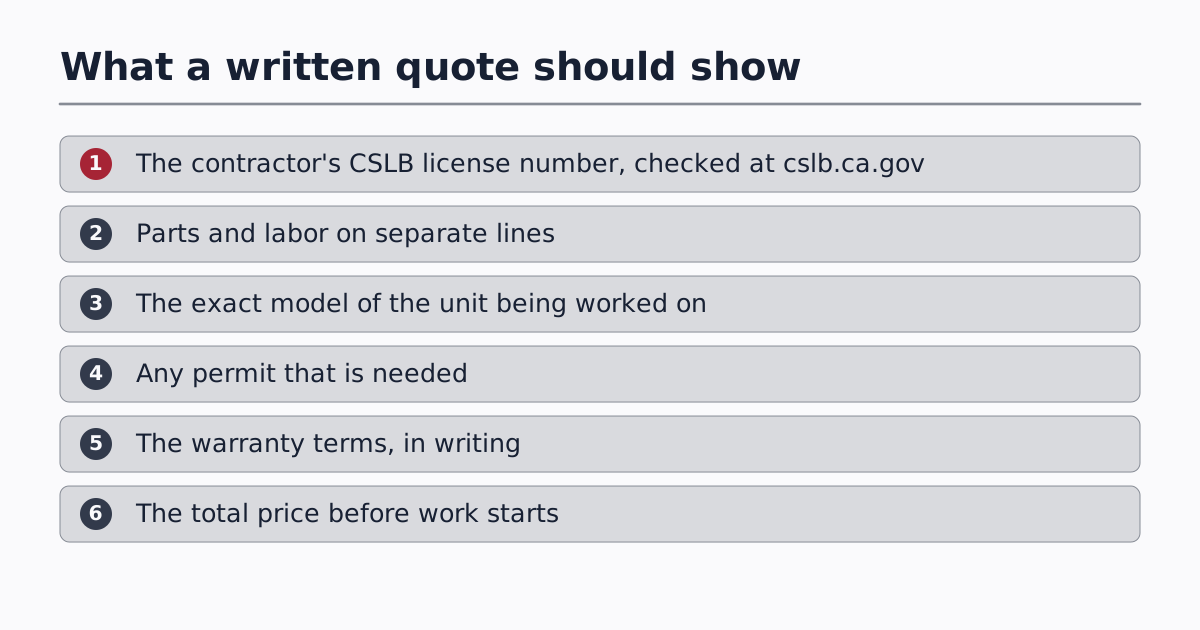
A written quote should name the work, the parts, the labor and the total, so you can compare it against another one line by line. If a number is vague, ask for it to be broken out before you sign anything.
Look for these items:
| Item | What it should say |
|---|---|
| Scope | What exactly will be repaired or installed, and on which unit |
| Parts | What is being replaced, new or used, and the brand where it applies |
| Labor | A flat price or an hourly rate with an estimated number of hours |
| Diagnostic fee | The amount, and whether it comes off the repair if you go ahead |
| Permit | Whether one is needed and who handles it |
| Extras | After-hours charges, disposal, or anything that could be added later |
For context, Fixr lists diagnostic or service call fees at roughly $75 to $250, often applied to the repair if you hire the same company. After-hours work often adds a surcharge; Fixr lists emergency rates at $150 to $300 per hour, or two to three times normal. These are national figures, not Modesto prices, so treat them as a way to spot an outlier, not as a rate card.
Compare at least two written quotes when the job is more than a small part. The price request page is one way to collect them, and you can read how that works on the how this works page.
What red flags should make me walk away?
Walk away when a specialist cannot or will not show you a license, pushes you to decide on the spot, or asks for most of the payment before any work starts. Those are the patterns that cause the most trouble for homeowners, and they are easy to spot once you know them.
Other warning signs:
- No written quote, only a verbal number.
- A price that changes the moment they open the unit, with no explanation.
- Refrigerant offered at a bargain with no mention of who is handling it. Under EPA Section 608, only technicians with EPA Section 608 certification may buy refrigerant for stationary air conditioning equipment, and knowingly venting it is prohibited.
- Pressure to replace a whole system when you called about a simple part, with no second opinion offered.
- No answer to "do I need a permit?"
On permits, Stanislaus County's planning fee schedule lists HVAC and wall or floor furnace permit fees. Confirm the current amount with the county before budgeting. Whether a like-for-like swap inside Modesto city limits needs one, ask the building department directly rather than relying on a contractor's say-so alone.
When should I call someone right away?
Call a specialist the same day when the system is a safety issue, not just a comfort issue. Furnaces can cause carbon monoxide poisoning if they are poorly maintained or have blocked venting. If a CO alarm sounds, go outside to fresh air and call 911, and do not go back in until responders say so.
Other reasons not to wait:
- A furnace that keeps locking out after repeated start attempts.
- Water running from your indoor unit, which can damage ceilings and floors. See the guide to AC water leaking.
- An air conditioner blowing warm air during a heat wave, especially with elderly people, infants or pets at home. Start with AC blowing warm air.
- A smell, noise or tripped breaker that comes back every time you switch the system on.
For anything that can wait a few days, use the time. Collect quotes, check licenses and ask your questions at a normal pace. Rushed decisions in the first cold snap of fall or the first hot week of summer are when homeowners pay the most for the least.
How do I get quotes without losing a week?
Write down the symptoms, the make and age of the unit if you know them, and when it last worked normally, then send the same description to every business you contact. Same details in, comparable quotes out. Taking photos of the unit's data label helps a specialist price the job accurately.
Useful details to have ready:
- Whether it is the furnace, the air conditioner, or both.
- What you see and hear: no heat, no cooling, noise, water, a code flashing on the board.
- What you have already tried, such as changing the filter or checking the breaker.
- Whether you rent or own, and whether the landlord needs to approve the work.
The HVAC repair home page lists the service pages and nearby towns covered.
Questions people ask
How long does it take to find a reliable heating and air specialist?
Checking a license takes a few minutes, and getting two or three written quotes usually takes a day or two when the problem is not an emergency. In a heat wave or cold snap, response times can stretch because many households call at once, so start the search as soon as you notice a problem rather than after it fails completely.
What should I ask before I hire someone for heating and air work?
Ask for the CSLB license number and look it up yourself, ask for a written quote with the diagnostic fee spelled out, and ask whether the work needs a permit. Also ask who will do the work, since a person who arrives may differ from the one who quoted, and ask what happens if the first fix does not solve the problem.
Do I need to be home for heating and air work?
Usually yes, at least at the start and the end. An adult should be able to show the technician the equipment, approve any change to the quote and see the system run before payment. If you cannot be there, agree in advance who will let them in and how you will approve extra work.
Is the $1,000 license rule the same for small repairs?
California requires a CSLB license for work valued at $1,000 or more in combined labor and materials. Splitting one job into smaller invoices does not get around the license requirement, so treat it as a warning sign. A small repair under that amount may fall below the license threshold, but checking a license is still a sensible habit for any heating or cooling work.
Can I check a contractor's license myself?
Yes. CSLB runs a free License Check on its website, cslb.ca.gov, and a phone line at 800-321-CSLB (2752). You can see whether the license is active and what classification it holds. Do this before you pay a deposit, not after.
Sources
- CSLB: What Kind of Contractor Do You Need?
- CSLB C-20 classification
- EPA Section 608 refrigerant sales restriction
- Fixr published cost guide, checked Nov 2026
Last updated