Carrier's lifespan table lists 15 to 20 years for a central air conditioner and 10 to 15 years for a heat pump. Those are estimates, not promises. In Modesto's long hot summers, a unit that runs for months each year tends to sit toward the shorter end unless it is maintained. The page on AC and HVAC replacement and installation covers what happens when the time comes.
The answer depends on the type of unit, how hard it works, how well it was installed and how it is looked after. This page gives the ranges for each equipment type, the factors that change them, the signs of the end of life, and the money side of repair versus replacement.
What is the average lifespan of an air conditioner?
Carrier's lifespan table lists 15 to 20 years for central AC and furnaces and 10 to 15 for heat pumps; its text gives a wider furnace range. Treat 15 to 20 years as the window for central AC, with care and climate deciding where you land.
| Equipment | Carrier's lifespan table |
|---|---|
| Central AC | 15 to 20 years |
| Furnace | 15 to 20 years |
| Heat pump | 10 to 15 years |
Carrier says its numbers are estimates, and they depend on use, installation and upkeep. When a unit is working hard, plan on the shorter end and be pleasantly surprised.
How long does a house AC unit last in the Central Valley?
Expect the lower half of the range if the unit works hard and gets little maintenance. Modesto's July average high is about 95 F, and from 2017 to 2026 Modesto logged between 12 and 45 days a year at or above 100 F, per Extreme Weather Watch (the 2026 count is incomplete). More running hours mean more wear on the compressor, fan motor and capacitor.
That is a reasonable inference, not a measured Modesto lifespan, because no source reviewed for this page gave a local figure. Carrier notes that maintenance, installation quality, usage and climate all matter.
Factors that move the number:
- Run hours. Months of daily cooling wear parts faster than occasional use.
- Maintenance. Clean filters, clear outdoor space and a yearly check. The page on HVAC maintenance and tune-ups lists the schedule.
- Installation quality. Correct sizing, sealed ducts and the right refrigerant charge.
- Coil and outdoor conditions. Dust, debris and airflow around the condenser.
- Equipment type. Heat pumps run all year and are often listed with shorter lifespans than AC-only systems.
When should I think about replacing an AC?
Carrier suggests considering replacement of an AC after about 10 years (about 15 for a furnace), especially with frequent repairs or rising energy bills. Carrier says costs that approach 50 percent of a new system's cost point toward replacing. Age alone is not a reason, but age plus a costly repair usually is.
Signs the system is near the end:
- Repair bills are rising year after year.
- It cools unevenly or struggles on hot afternoons.
- Energy bills climb with no change in use.
- It uses an older refrigerant that is getting costlier to service.
- The compressor, coil or another major part has failed.
- Frequent short cycling, noises or breaker trips.
Rules of thumb help with the decision. The 50 percent test above comes from Carrier. The other is a common rule of thumb, not from a manufacturer: multiply the repair cost by the age of the system. If the number is above 5,000, replacement is usually the better value. A $700 repair on a 12-year-old unit scores 8,400, for example.
What does it cost to replace an AC?
Fixr's 2026 guide puts the average installed central AC near $6,000; its 3-ton range is $2,500 to $8,000. Those are national figures, not Modesto prices, and the final quote depends on size, ducts and the work needed.
Compare that with common repairs. Fixr's AC repair guide (January 2026) lists compressor work at $600 to $3,000 and refrigerant leak repair at $200 to $1,500. Those repair lines are worth setting against a replacement quote when the unit is old.
See replacement HVAC cost for the full picture and AC repair cost if you are weighing a fix.
What matters when I choose and install a new AC?
Choose the right size, a rating that meets the California minimum and a well-run installation. Under DOE's 2023 standards, a split central AC under 45,000 Btu/h must meet 14.3 SEER2 in California (Southwest region). A higher SEER rating costs more up front and uses less electricity.
Points to cover in any HVAC installation quote:
- Sizing. A professional should confirm the size with a Manual J load calculation, and oversized systems short-cycle and remove less humidity.
- Seer rating and model. Compare the rating, the model number and the warranty.
- Refrigerant. New equipment made after January 2025 uses A2L refrigerants such as R-454B or R-32. EPA's May 2026 final rule removed the January 1, 2026 installation deadline for most residential R-410A systems made before 2025, so check EPA's Technology Transitions page and local rules.
- Ducts. Leaky ducts waste the efficiency you paid for.
- Permit. Stanislaus County lists HVAC permits among the ones it accepts online. For a Modesto city address, ask the building department.
- Rebates. Modesto Irrigation District has listed rebates for heat pumps and central AC in the past, but listings conflict. Confirm what is available with MID at (209) 526-7339 before relying on it.
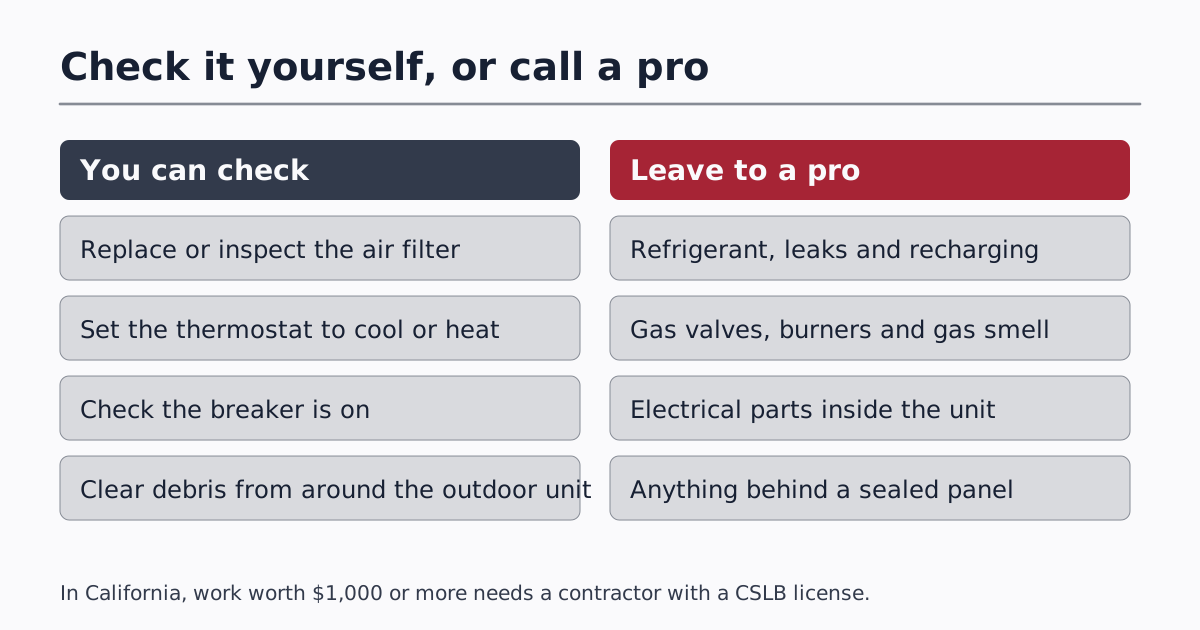
- License. Work worth $1,000 or more needs a contractor who holds a CSLB license. Verify at cslb.ca.gov.
Other questions about "how long does AC last"
The phrase "how long does AC last" brings up unrelated searches. This page is about home air conditioning.
- How long does an AC charge last? A home AC does not use up refrigerant. Carrier says low refrigerant is not normal for a properly sealed system, so a recharge that fades means a leak.
- How long does an AC condenser last? The condenser is the outdoor part, and it is usually replaced with the system, or as a repair if it fails early.
- How long does a car AC or a Delco battery last? Those are vehicle questions and are not covered here.
- How long does Pepcid AC last, or an AC pill? Those are medicines. Read the label or ask a pharmacist or doctor. This site gives no medical advice.
How do I get quotes for a replacement project?
Collect two or three written quotes with the same scope: unit size, rating, brand and model, ducts, permit, removal of the old system and warranty terms. Compare totals and details. Check each contractor's license at cslb.ca.gov.
Start with the price request page. The home page lists other cooling and heating topics.
Questions people ask
What is the average lifespan of an AC unit?
About 15 to 20 years per Carrier's lifespan table. Use maintenance, repair history and age to judge where yours stands.
How long does an HVAC repair or replacement take?
Many repairs take one visit of an hour or two. A full AC replacement is often one to two days, longer if ducts, wiring or a permit inspection are involved. Ask for the schedule in the written quote and confirm who handles the permit.
What should I ask before I hire someone for HVAC repair or replacement?
Ask for the CSLB license number, a written quote with the diagnostic fee, equipment model and rating, permit plan, warranty terms and how they calculated the size. Ask who will do the work and what happens if the first fix does not solve it.
Does a higher SEER rating make an AC last longer?
Not by itself. A higher rating means it uses less electricity for the same cooling. Lifespan depends more on installation quality, maintenance, run hours and climate. Choose by size and installation quality first, then rating.
Can regular maintenance extend the life of my AC?
It helps. Carrier lists maintenance among the factors that affect lifespan, and yearly checks catch worn parts before they fail. Maintenance cannot stop age, but it can keep the unit near the long end of the range.
Sources
- Carrier: how long do HVAC systems last
- Carrier minimum efficiency standards
- US Department of Energy, 2023 energy conservation standards FAQ
- Fixr AC installation guide, published national cost guide, checked Nov 2026
- Fixr HVAC repair cost article, published national cost guide, checked Nov 2026
Last updated