HVAC maintenance means a specialist inspects, cleans and tests your cooling and heating equipment on a set schedule, usually once a year for each system. For a typical Modesto home that means an air conditioner check in spring, before summer, and a furnace check in early fall, before the first cold nights. The overview of maintenance and tune-ups explains plans and what they include.
Fixr's maintenance guide lists a tune-up at about $275, and maintenance plans at $150 to $500 a year. These are national figures, not Modesto prices. The sections below cover what is done on the visit, how to tell you need one, how often, and what the decision rules like the 5,000 rule mean.
What maintenance does an AC unit need?
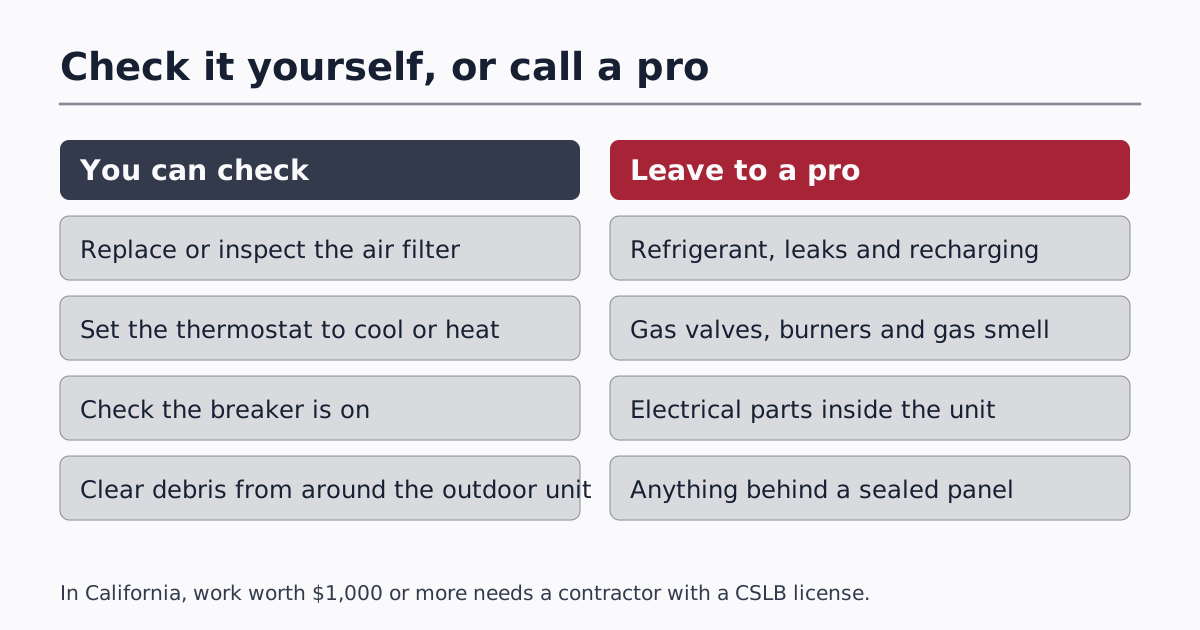
An AC needs a clean filter every one to three months, a clear outdoor unit and a yearly professional check of the coil, refrigerant level, electrical parts, drain line and airflow. The first two are yours. The rest belong to a specialist because they involve electrical parts and refrigerant.
The split looks like this:
| Task | Who | How often |
|---|---|---|
| Replace air filters | You | Every 1 to 3 months |
| Keep the outdoor unit clear | You | Monthly in summer |
| Check thermostat and vents | You | Each season |
| Inspect coils, drain line and drain pan | Specialist | Yearly |
| Test capacitor, contactor and fan motor | Specialist | Yearly |
| Check refrigerant level and look for leaks | Specialist | Yearly |
| Measure airflow and temperature drop | Specialist | Yearly |
The homeowner side is covered on the page about clean and service HVAC tasks you can do yourself. This page is about the professional visit. The line between the two matters: only technicians with EPA Section 608 certification, or their employers, may buy refrigerant for stationary AC equipment, and knowingly venting it is prohibited, so a refrigerant check is never a DIY job.
How do I know if my AC needs a tune-up?
Your AC needs a tune-up if it is more than a year since the last one, or if you notice warm air, weak airflow, longer run times, noises, a rising energy bill, odd smells or water around the unit. Any of these can be a symptom that a check would catch early.
Watch for:
- Rooms that no longer cool evenly.
- The system running longer to reach the same temperature.
- Ice on the coil or lines.
- Noise from the outdoor unit when it starts.
- Higher bills with no change in use.
- A tripped breaker.
If the system has stopped cooling already, a tune-up is the wrong request. That is a repair, so read about AC blowing warm air and ask for a diagnosis.
What does a professional tune-up actually include?
A tune-up is a checklist visit: the specialist inspects, cleans and tests the system, measures how it is performing and reports what needs attention. It is not a repair visit, though they may fix small items. The exact list differs between businesses, so ask for it in writing.
Typical items on an AC tune-up:
- Inspect and clean the indoor and outdoor coils where needed.
- Check the filter and the drain line and pan.
- Test electrical connections, the capacitor and the contactor.
- Check the refrigerant level and look for signs of a leak.
- Measure airflow and the temperature drop across the coil.
- Test the thermostat and run a full cooling cycle.
A heating tune-up adds a check of the burners, ignition, flame sensor, heat exchanger and venting, and a carbon monoxide test. The CPSC urges a professional inspection of furnaces and other fuel-burning heating systems, chimneys, flues and vents every year, because poor maintenance and blocked venting can cause carbon monoxide poisoning. See furnace repair and service for the heating side.
Do you really need an AC tune-up?
Yes for most households, but a tune-up is not magic. It helps catch worn parts, clogged drains and slow leaks before a hot week, and the Energy Star heating and cooling guide hosted by the Department of Energy says regular maintenance can reduce heating and cooling costs by 10 percent or more. It does not extend the life of a system past what its age and use allow.
The honest difference between a tune-up and a repair: a tune-up looks for trouble, and a repair fixes trouble you already have. A tune-up on a failing system will often turn into a repair quote.
Reasons it pays off in this climate:
- Summers are long and hot. Climate data for 1991 to 2020 puts the July average high near 95 F, and from 2017 to 2026 Modesto logged between 12 and 45 days a year at or above 100 F, per Extreme Weather Watch (the 2026 count is incomplete).
- A system that runs for months with a dirty coil works harder and costs more to run.
- Finding a weak capacitor in spring is cheaper than finding it in a heat wave. Fixr lists capacitor replacement at $100 to $400.
How often does HVAC need a tune-up?
Once a year for cooling and once a year for heating is the usual schedule. Book the AC check in spring, before summer demand builds, and the furnace check in early fall, before the first cold snap.
Why the timing matters in the Valley:
- Spring: you want the AC ready before the first run of 100 degree days.
- Early fall: you want the furnace tested while there is still time to order a part before cold weather.
Some people combine both checks in one visit. That can work if the specialist is qualified for both and the visit covers each system properly. Compare the written scope against two separate visits.
What does HVAC maintenance cost?
Fixr's maintenance guide lists a tune-up at about $275. Maintenance plans run $150 to $500 per year, and some include a tune-up while others only discount one. Diagnostic and service call fees are separate, at $75 to $250 per Fixr.
Read the plan before you buy. Ask:
- How many visits per year are included, and for which equipment.
- Whether parts and labor on repairs are discounted, and by how much.
- Whether priority scheduling is real, and in writing.
- What the cancellation rules are.
The page on HVAC tune-up cost goes through the ranges, and HVAC service and maintenance explains what the visits cover. Check any contractor's CSLB license at cslb.ca.gov before you sign.
What is the 5,000 rule for HVAC systems?
The 5,000 rule is a common rule of thumb, not from a manufacturer: multiply the repair cost by the system's age in years, and if the result is above 5,000, replacement may be the better choice. A $600 repair on a 10-year-old system scores 6,000, so replacement is worth pricing. It is not a law.
Carrier's guidance is separate: repairs that approach 50 percent of a new system's cost favor replacement. Carrier suggests considering replacement of an AC or heat pump after about 10 years and of a furnace after about 15 years, especially with frequent repairs.
Maintenance gives you the information to apply these rules. A yearly report shows which parts are wearing and how the system measures up. For lifespans, read how long an AC lasts.
To request quotes for a tune-up or a repair, use the price request page. The home page lists the rest of the topics.
If you are still deciding who to call, read what cooling and heating repairs share, and where they differ.
Questions people ask
How often should an air conditioning unit be serviced?
Once a year by a professional, ideally in spring before summer, with a filter change every one to three months in between. If the system runs almost constantly in a heat wave, or you have pets or a dusty home, check the filter more often and keep the yearly visit.
What is the average cost to service an air conditioner?
Fixr lists a tune-up at about $275, and maintenance plans at $150 to $500 a year. A diagnostic or service call fee is separate, $75 to $250 per Fixr. These are national figures, so local quotes may differ.
What is the average lifespan of an AC unit?
Carrier's lifespan table lists 15 to 20 years for central AC, as an estimate, not a promise. Climate, installation quality and maintenance all move the number, and Modesto's hot summers put steady load on equipment.
What are the top 3 HVAC systems?
There is no reliable ranking that fits every home. The system that suits you depends on the size of the house, the ducts, the climate and the installation quality. A well-sized unit, installed properly and maintained, matters more than the badge on the cabinet. Compare written quotes.
Do I need to be home for a tune-up?
Yes, an adult should be there to give access to the indoor and outdoor units, hear the findings and approve any extra work. Ask for the findings in writing, with photos of anything that needs a repair.
Sources
- Fixr HVAC maintenance guide
- Fixr AC repair cost guide (January 2026)
- CPSC: Stay safe while staying warm
- Carrier: how long do HVAC systems last
- Energy Star heating and cooling guide, hosted by the U.S. Department of Energy
Last updated